
implant systems
NeoBiotech implants: what this system is and why it is chosen
When a patient hears that the implant is made in Korea, the first question is almost always the same: "why not Straumann?" It is a fair question — and the answer is more interesting than it looks.
Who NeoBiotech are
The company was founded in South Korea in 2000 and makes implants, surgical instruments and prosthetic components. Its current systems, IS-II Active and IS-III Active, hold FDA and CE regulatory clearances.
A clearance on its own does not make one implant better than another. What it does is separate a medical device with manufacturing control from an unbranded product — which is exactly the worry behind the word "Korean".
Over the past twenty years South Korea has become one of the centres of implant dentistry, and its systems are used well beyond Asia.
The SLA surface
An implant holds in bone not through smooth titanium but through a micro-roughened surface. SLA is sandblasting followed by acid etching, which creates that texture and the conditions for contact with bone tissue.
The technology is not experimental: Straumann itself grew on the development of its own SLA surface, later adding the hydrophilic SLActive.
At the fundamental level both systems solve the same task the same way.
Primary stability
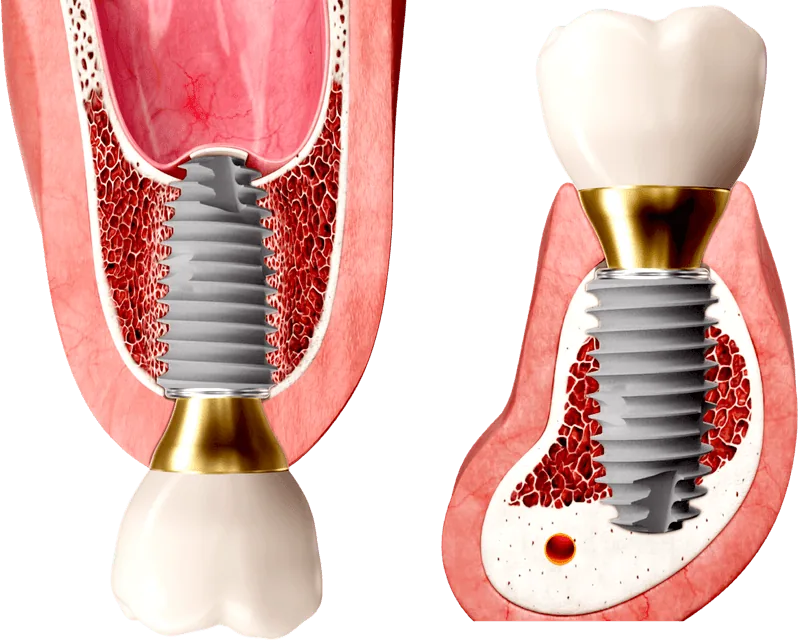
Before biological integration has formed, the implant is held mechanically — by how tightly it sits in the bone right after placement. That is primary stability.
The geometry of IS-III Active was designed with an emphasis on it. For the patient this matters where the surgeon is considering early or immediate loading.
The timing of loading is decided by the surgeon, after assessing bone quality and the stability of that particular implant. The brand does not decide it.
An implant is a system, not a screw
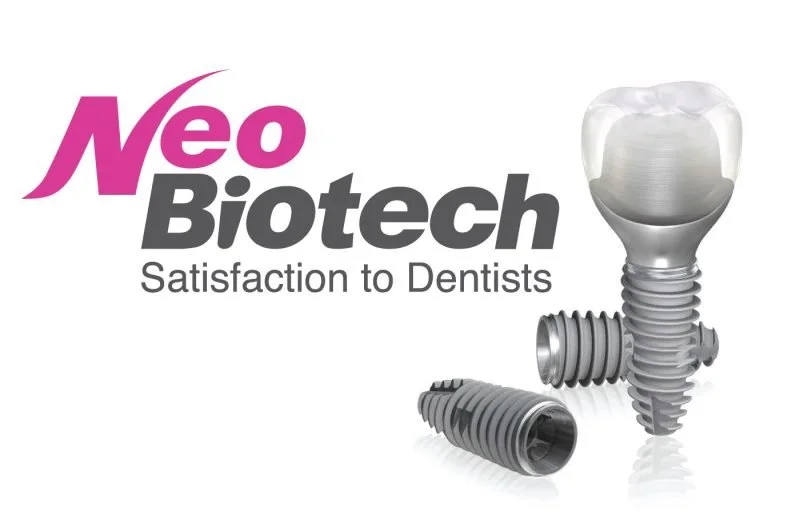
It looks as if an implant is a titanium screw and the only difference is the name. In practice these work together: body geometry, thread shape and depth, the apical part, the surface, the connection to the abutment, the surgical protocol, the size range, digital planning and the quality of the prosthetic components.
The surgical and prosthetic halves of a system have to work together. That is why a doctor's experience with this particular system often counts for more than the logo on the box.
What actually determines the outcome
Even the most expensive implant does not exist apart from the doctor and the clinical situation. The outcome is shaped by bone volume and quality, implant position, the surgical protocol, primary stability, the state of the gums, the future restoration and how load is distributed, general health, smoking, hygiene and follow-up after treatment.
A Straumann implant placed incorrectly does not become good because of the logo.
Straumann and NeoBiotech side by side
The research row is stated as it is. Naming the other side's advantage outright is what makes the whole table worth trusting.
A direct comparison: randomized trial, 2024
In 2024 Seoul National University published a randomized controlled trial that compared Straumann BLT NC SLActive directly against two narrow NeoBiotech IS-III Active models. The implants were placed in the mandibular incisor area with immediate temporary loading, and follow-up ran for one year.
The authors' conclusion: all three types of narrow-diameter implants showed acceptable clinical and radiographic results.
The sample is small — 21 patients, seven per group — and the situation is specific: narrow implants, the lower front, immediate loading. The result cannot be carried over to every clinical situation.
But on the original question — whether there is any basis for treating a Korean system as inherently weaker purely because of where it is made — the trial answers: there is not.
Ahn J.-H., Lim Y.-J., Lee J., Baek Y.-W., Kim M.-J., Kwon H.-B. — Bioengineering, 12.03.2024doi.org/10.3390/bioengineering11030272
The right question sounds different
Not "Switzerland or Korea", but why the doctor chose this system for your case, what the treatment plan will be, and who performs the surgery and the restoration. Those are the questions a conversation with the surgeon answers — before payment and before the trip.
The information on this page is for general guidance only and is not medical advice or a recommendation of any particular implant system. The system is chosen by the doctor according to the clinical situation.
Brand names are used for identification only and belong to their owners. GEO Medical coordinates the trip and is not the medical party.